

Để sử dụng toàn bộ tiện ích nâng cao của Hệ Thống Pháp Luật vui lòng lựa chọn và đăng ký gói cước.
| THE MINISTRY OF INFORMATION AND COMMUNICATIONS | THE SOCIALIST REPUBLIC OF VIETNAM |
| No. 10/2019/TT-BTTTT | Hanoi, October 04, 2019 |
CIRCULAR
PROMULGATION OF “NATIONAL TECHNICAL REGULATION ON ELECTROMAGNETIC COMPATIBILITY FOR MOBILE TERMINALS AND ANCILLARY EQUIPMENT OF DIGITAL CELLULAR TELECOMMUNICATION SYSTEMS”
Pursuant to the Law on Standards and Technical Regulations dated June 29, 2006;
Pursuant to the Law on Telecommunications dated November 23, 2009;
Pursuant to the Law on Frequencies dated November 23, 2009;
Pursuant to the Government's Decree No. 127/2007/ND-CP dated August 01, 2007 on elaboration of the Law on Standards and Technical Regulations;
Pursuant to the Government's Decree No. 78/2018/ND-CP dated May 16, 2018 on amendments to the Government's Decree No. 127/2007/ND-CP dated August 01, 2007 on elaboration of the Law on Standards and Technical Regulations;
Pursuant to the Government's Decree No. 17/2017/ND-CP dated February 17, 2017 defining the functions, tasks, powers and organizational structure of the Ministry of Information and Communications;
...
...
...
Mọi chi tiết xin liên hệ: ĐT: (028) 3930 3279 DĐ: 0906 22 99 66
The Minister of Information and Communications hereby promulgates a Circular on National technical regulation on electromagnetic compatibility for mobile terminals and ancillary equipment of digital cellular telecommunication systems.
Article 2. Effect
1. This Circular comes into force from July 01, 2020.
2. The Circular No. 02/2015/TT-BTTTT dated February 27, 2015 of the Minister of Information and Communications shall cease to have effect from July 01, 2020.
Article 3. Chief of Office, Director General of the Department of Science and Technology, heads of agencies and units affiliated to the Ministry of Information and Communications, Directors of Departments of Information and Communications of provinces and central-affiliated cities and relevant organizations and individuals are responsible for the implementation of this Circular./.
THE MINISTER
Nguyen Manh Hung
...
...
...
Mọi chi tiết xin liên hệ: ĐT: (028) 3930 3279 DĐ: 0906 22 99 66
QUY CHUẨN KỸ THUẬT QUỐC GIA
VỀ TƯƠNG THÍCH ĐIỆN TỪ CHO THIẾT BỊ ĐẦU CUỐI VÀ PHỤ TRỢ TRONG HỆ THỐNG THÔNG TIN DI ĐỘNG
National technical regulation
on electromagnetic compatibility for mobile terminals and ancillary equipment of digital cellular telecommunication systems
Contents
1. GENERAL
1.1. Scope
1.2. Regulated entities
...
...
...
Mọi chi tiết xin liên hệ: ĐT: (028) 3930 3279 DĐ: 0906 22 99 66
1.4. Definitions
1.5. Symbols
1.6. Abbreviations
2. TECHNICAL REQUIREMENTS
2.1. Emission
2.1.1. GSM and DCS
2.1.2. CDMA Direct Spread (UTRA and E-UTRA)
2.2. Immunity
2.2.1. GSM and DCS
...
...
...
Mọi chi tiết xin liên hệ: ĐT: (028) 3930 3279 DĐ: 0906 22 99 66
2.3. Test conditions
2.3.1. General
2.3.2. Arrangements for test signals
2.3.3. Exclusion bands
2.3.4. Narrow band responses of receivers and receivers of duplex transceivers
2.3.5. Normal test modulation
2.4. Performance assessment
2.4.1. General
2.4.2. Equipment which can provide a continuous communications link
...
...
...
Mọi chi tiết xin liên hệ: ĐT: (028) 3930 3279 DĐ: 0906 22 99 66
2.4.4. Ancillary equipment
2.4.5. Equipment classification
2.5. Performance criteria
2.5.1. GSM and DCS Performance Criteria
2.5.2. CDMA Direct Spread (UTRA and E-UTRA) Performance Criteria
3. MANAGEMENT REGULATIONS
4. RESPONSIBILITIES OF ORGANIZATIONS AND INDIVIDUALS
5. IMPLEMENTATION
Annex A (normative) CDMA Direct Spread Performance assessment voice call. Audio breakthrough
...
...
...
Mọi chi tiết xin liên hệ: ĐT: (028) 3930 3279 DĐ: 0906 22 99 66
Annex C (informative) Examples of cellular mobile terminals and ancillary equipment
Bibliography
Foreword
QCVN 86:2019/BTTTT replaces QCVN 86:2015/BTTTT.
QCVN 86:2019/BTTTT contains technical requirements that conform to ETSI EN 301 489-52 V1.1.0 (2016-11) of the European Telecommunications Standards Institute (ETSI).
QCVN 86:2019/BTTTT is prepared by the Research Institute of Posts and Telecommunications, appraised and submitted by the Department of Science and Technology for approval, and promulgated together with the Circular No. 10/2019/TT-BTTTT dated October 04, 2019 by the Ministry of Information and Communications.
NATIONAL TECHNICAL REGULATION
ON ELECTROMAGNETIC COMPATIBILITY FOR MOBILE TERMINALS AND ANCILLARY EQUIPMENT OF DIGITAL CELLULAR TELECOMMUNICATION SYSTEMS
...
...
...
Mọi chi tiết xin liên hệ: ĐT: (028) 3930 3279 DĐ: 0906 22 99 66
- GSM, DCS (IMT-2000, Technology GSM/EDGE) (see Annex C);
- UTRA, WCDMA (IMT-2000 Direct Spread, W-CDMA FDD);
- E-UTRA, LTE (IMT-2000 and IMT advanced) (see Annex C).
and associated ancillary equipment.
Technical specifications related to the antenna port and emissions from the enclosure port of radio equipment are not included in the present document. Such technical specifications are found in the relevant product standards for the effective use of the radio spectrum.
The present document only covers public terrestrial mobile terminals on the List of potentially unsafe commodities under management of the Ministry of Information and Communications.
The present document applies to Vietnamese and foreign organizations and individuals involved in manufacturing and sale of equipment in the scope of this document within the territory of Vietnam.
QCVN 18:2014/BTTTT “National technical regulation on General Electromagnetic Compatibility for Radio Communications Equipment”
ETSI TS 134 108 (V6.4.0) (10-2006): Universal Mobile Telecommunications System (UMTS); Common test environments for User Equipment (UE); Conformance testing (3GPP TS 34.108 version 6.4.0 Release 6).
...
...
...
Mọi chi tiết xin liên hệ: ĐT: (028) 3930 3279 DĐ: 0906 22 99 66
ETSI TS 134 109 (V6.2.0) (09-2006): Universal Mobile Telecommunications System (UMTS); Terminal logical test interface; Special conformance testing functions (3GPP TS 34.109 version 6.2.0 Release 6)
ETSI EN 300 296-1 (V1.4.1) (2013): Electromagnetic compatibility and Radio spectrum Matters (ERM); Land Mobile Service; Radio equipment using integral antennas intended primarily for analogue speech; Part 1: Technical characteristics and methods of measurement.
Recommendation ITU-T P.64 (1999): Telephone transmission quality, Telephone installations, Local line networks, Objective electro-acoustical measurements. Determination of sensitivity/frequency characteristics of local telephone systems.
Recommendation ITU-T P.76 (1988): Telephone transmission quality, Measurements related to speech loudness, Determination of loudness ratings; Fundamental principles, Annex A.
ETSI TS 125 102 (V7.4.0) (10-2006): Universal Mobile Telecommunications System (UMTS); User Equipment (UE) radio transmission and reception (TDD) (3GPP TS 25.102 version 7.4.0 Release 7).
ETSI TS 136 101 (V8.4.0) (01-2009): LTE; Evolved Universal Terrestrial Radio Access (E-UTRA); User Equipment (UE) radio transmission and reception (3GPP TS 36.101 version 8.4.0 Release 8).
ETSI TS 136 508 (V8.1.0) (04-2009): LTE; Evolved Universal Terrestrial Radio Access (E-UTRA) and Evolved Packet Core (EPC); Common test environments for User Equipment (UE) conformance testing (3GPP TS 36.508 version 8.1.0 Release 8).
ETSI TS 136 509 (V8.0.1) (01-2009): LTE; Evolved Universal Terrestrial Radio Access (E-UTRA); Special conformance testing function for User Equipment (UE) (3GPP TS 36.509 version 8.0.1 Release 8).
ETSI I-ETS 300 034-1 (Edition 1) (10-1993): European digital cellular telecommunications system (Phase 1); Radio subsystem link control (GSM 05.08).
...
...
...
Mọi chi tiết xin liên hệ: ĐT: (028) 3930 3279 DĐ: 0906 22 99 66
ETSI ETS 300 578 (Edition 13) (03-1999): Digital cellular telecommunications system (Phase 2) (GSM); Radio subsystem link control (GSM 05.08 V4.22.0).
ETSI TS 100 911 (V8.23.0) (11-2005): Digital cellular telecommunications system (Phase 2+); Radio subsystem link control (3GPP TS 05.08 version 8.23.0 Release 1999).
information transmission path of defined characteristics for transfer of user data or predefined test data.
UE is in idle mode and has completed the cell selection/reselection process and has chosen a cell.
NOTE 1: The UE monitors system information and (in most cases) paging information.
NOTE 2: The services may be limited, and the PLMN may not be aware of the existence of the UE within the chosen cell.
RF bandwidth supporting a single E-UTRA RF carrier with the transmission bandwidth configured in the uplink or downlink of a cell.
NOTE: The channel bandwidth is measured in MHz and is used as a reference for transmitter and receiver RF requirements.
ancillary which provides send and/or receive data access to UMTS services via UE.
...
...
...
Mọi chi tiết xin liên hệ: ĐT: (028) 3930 3279 DĐ: 0906 22 99 66
For UTRA/EUTRA equipment: state of User Equipment (UE) when switched on but with no Radio Resource Control (RRC) connection.
For GSM: mode of operation of a receiver or a transceiver, where the Equipment Under Test (EUT) is powered, available for service and available to respond to a request to set up a call.
average transmitter output power obtained over any specified time interval, including periods with no transmission, when the transmit time slots are at the maximum power setting.
maximum achievable throughput for a reference measurement channel.
for a given class of emission, the width of the frequency band which is just sufficient to ensure the transmission of information at the rate and with the quality required under specified conditions.
measure of the received signal quality, which is generated by the mobile or portable equipment, for use as a criterion in the Radio Frequency (RF) power control and handover processes
NOTE: For more information see:
- ETSI ETS 300 034-1 clause 8.2 for Phase 1 GSM 900 equipment;
- ETSI ETS 300 034-2 clause 8.2 for Phase 1 DCS 1800 equipment; or
...
...
...
Mọi chi tiết xin liên hệ: ĐT: (028) 3930 3279 DĐ: 0906 22 99 66
- ETSI TS 100 911 clause 8.2 for Phase 2+ GSM 900 or Phase 2+ DCS 1800 equipment.
state of User Equipment (UE) when switched on and with Radio Resource Control (RRC) connection established.
number of payload bits successfully received per second for a reference measurement channel in a specified reference condition.
entity capable of accessing a set of cellular services via one or more radio interfaces.
NOTE: This entity may be stationary or in motion within the cellular service area while accessing the Cellular services, and may simultaneously serve one or more users.
BWChannel Channel Bandwith
m meters
AC
Alternating Current
...
...
...
Mọi chi tiết xin liên hệ: ĐT: (028) 3930 3279 DĐ: 0906 22 99 66
ARFCN
Absolute Radio Frequency Channel Number
BCCH
Broadcast Control Channel
BER
Bit Error Ratio
...
...
...
Mọi chi tiết xin liên hệ: ĐT: (028) 3930 3279 DĐ: 0906 22 99 66
Block Error Ratio
BPF
Band Pass Filter
BTS
Base Transceiver Station
CCCH
...
...
...
Mọi chi tiết xin liên hệ: ĐT: (028) 3930 3279 DĐ: 0906 22 99 66
CDMA
Code Division Multiple Access
CW
Continuous Wave (unmodulated carrier wave)
DC
Direct Current
...
...
...
Mọi chi tiết xin liên hệ: ĐT: (028) 3930 3279 DĐ: 0906 22 99 66
DCS
Digital Cellular telecommunications System
DL
Down Link (From BTS to UE)
DTX
Discontinuous Transmission
...
...
...
Mọi chi tiết xin liên hệ: ĐT: (028) 3930 3279 DĐ: 0906 22 99 66
E-UTRA Absolute Radio Frequency Channel Number
EMC
Electromagnetic Compatibility
EPC
Evolved Packet Core
ESD
...
...
...
Mọi chi tiết xin liên hệ: ĐT: (028) 3930 3279 DĐ: 0906 22 99 66
EUT
Equipment Under Test (UE or UE with ancillaries)
E-UTRA
Evolved Universal Terrestrial Radio Access
FDD
Frequency Division Duplex
...
...
...
Mọi chi tiết xin liên hệ: ĐT: (028) 3930 3279 DĐ: 0906 22 99 66
FRC
Fixed Reference Channel
GSM
Global System for Mobile Communications
PCCPCH
Primary Common Control Physical Channel
...
...
...
Mọi chi tiết xin liên hệ: ĐT: (028) 3930 3279 DĐ: 0906 22 99 66
Radio Frequency
rms
root mean square
RRC
Radio Resource Control
SPL
...
...
...
Mọi chi tiết xin liên hệ: ĐT: (028) 3930 3279 DĐ: 0906 22 99 66
TCH
Traffic channel
TDD
Time Division Duplex
UARFCN
UTRA Absolute Radio Frequency Channel Number
...
...
...
Mọi chi tiết xin liên hệ: ĐT: (028) 3930 3279 DĐ: 0906 22 99 66
UE
User Equipment
UL
Up Link (From UE to BTS)
UMTS
Universal Mobile Telecommunication System
...
...
...
Mọi chi tiết xin liên hệ: ĐT: (028) 3930 3279 DĐ: 0906 22 99 66
Universal Terrestrial Radio Access
EMC emission measurements for ports of radio and/or associated ancillary equipment are provided in Table 1 in QCVN 18:2014/BTTTT (see Table 1) and conditions are set out in Table 2 of the present document.
Table 1. EMC emission measurements for mobile terminals and ancillary equipment of GSM and DCS under Table 1, QCVN 18:2014/BTTTT
Phenomenon
Application
Equipment test requirement
Reference clause in QCVN 18:2014/BTTTT
Radio and ancillary equipment for fixed use (e.g. base station equipment)
...
...
...
Mọi chi tiết xin liên hệ: ĐT: (028) 3930 3279 DĐ: 0906 22 99 66
Radiated emission
enclosure of ancillary equipment
applicable for stand alone testing
applicable for stand alone testing
2.1.3
Conducted emission
DC power input/output port
Applicable
Not applicable
...
...
...
Mọi chi tiết xin liên hệ: ĐT: (028) 3930 3279 DĐ: 0906 22 99 66
Conducted emission
AC power input/output port
Not applicable
Not applicable
2.1.5
harmonic current emissions
AC mains input port
Not applicable
Not applicable
...
...
...
Mọi chi tiết xin liên hệ: ĐT: (028) 3930 3279 DĐ: 0906 22 99 66
Voltage fluctuations and flicker
AC mains input port
Not applicable
Not applicable
2.1.7
Conducted emission
Telecommunication port
Not applicable
Not applicable
...
...
...
Mọi chi tiết xin liên hệ: ĐT: (028) 3930 3279 DĐ: 0906 22 99 66
Table 2. Conditions for EMC emission measurements for mobile terminals and ancillary equipment of GSM and DCS
Reference clause in QCVN 18:2014/BTTTT
Conditions for measurements, additional to or modifying Clause 2.1 in QCVN 18:2014/BTTTT
2.1.3 “Enclosure of ancillary equipment measured on a stand alone basis”
At the manufacturer's discretion, ancillary equipment can also be measured in combination with the radio equipment under test. When the ancillary equipment is measured in combination with the radio equipment, radiated emissions from the transmitter/transceiver shall be ignored, but recorded in the test report.
EMC emission measurements for ports of radio and/or associated ancillary equipment are provided in Table 1 in QCVN 18:2014/BTTTT (see Table 1).
EMC immunity measurements for ports of radio and/or associated ancillary equipment are provided in Table 2 in QCVN 18:2014/BTTTT (see Table 3) and conditions are set out in Table 4 of the present document.
Table 3. MC emission measurements for mobile terminals and ancillary equipment of GSM and DCS under Table 2, QCVN 18:2014/BTTTT
Phenomenon
...
...
...
Mọi chi tiết xin liên hệ: ĐT: (028) 3930 3279 DĐ: 0906 22 99 66
Equipment test requirement
Reference clause in QCVN 18:2014/BTTTT
Radio and ancillary equipment for fixed use (e.g. base station equipment)
Radio and ancillary equipment for vehicular use (e.g. mobile equipment)
RF electromagnetic field (80 MHz to 1 000 MHz and 1 400 MHz to 2 700 MHz)
enclosure
Applicable
Applicable
2.2.3
...
...
...
Mọi chi tiết xin liên hệ: ĐT: (028) 3930 3279 DĐ: 0906 22 99 66
enclosure
Not applicable
Applicable
2.2.4
Fast transients, common mode
signal, telecommunication and control ports, DC and AC power ports
Not applicable
Not applicable
2.2.5
...
...
...
Mọi chi tiết xin liên hệ: ĐT: (028) 3930 3279 DĐ: 0906 22 99 66
signal, telecommunication and control ports, DC and AC power ports
Applicable
Not applicable
2.2.6
transients and surges
DC power input ports
Applicable
Not applicable
2.2.7
...
...
...
Mọi chi tiết xin liên hệ: ĐT: (028) 3930 3279 DĐ: 0906 22 99 66
AC mains input port
Not applicable
Not applicable
2.2.8
surges, line to line and line to ground
AC mains power input ports, telecommunication ports
Not applicable
Not applicable
2.2.9
...
...
...
Mọi chi tiết xin liên hệ: ĐT: (028) 3930 3279 DĐ: 0906 22 99 66
Reference clause in QCVN 18:2014/BTTTT
Conditions for measurements, additional to or modifying Clause 2.2 in QCVN 18:2014/BTTTT
2.2.3 “Radio frequency electromagnetic field”, “Test method” clause
When using the max hold detector method at each test frequency step initially an unmodulated test signal shall be applied. Then the test modulation shall be applied.
The test shall be repeated with the equipment in the idle mode of operation and the exclusion band shall not be used during this test.
2.2.6 “Radio frequency, common mode”, “Test method” clause
When using the max hold detector method at each test frequency step initially an unmodulated test signal shall be applied. Then the test modulation shall be applied.
The stepped frequency increments may be 50 kHz increment of the momentary frequency in the frequency range 150 kHz to 5 MHz. When using the max hold detector method, initially at each test frequency step an unmodulated immunity test signal shall be applied. Then the modulation of the immunity RF test signal (1 kHz tone) shall be applied as specified in QCVN 18:2014/BTTTT.
...
...
...
Mọi chi tiết xin liên hệ: ĐT: (028) 3930 3279 DĐ: 0906 22 99 66
During tests with pulses 3a and 3b, the performance criteria TT shall apply (see clause 2.5.1.3).
EMC immunity measurements for ports of radio and/or associated ancillary equipment are provided in Table 2 in QCVN 18:2014/BTTTT (see Table 3) and conditions are set out in Table 5 of the present document.
Table 5. Conditions for immunity measurements for mobile terminals and ancillary equipment of CDMA Direct Spread (UTRA and E-UTRA)
Reference clause in QCVN 18:2014/BTTTT
Conditions for measurements, additional to or modifying Clause 2.2 in QCVN 18:2014/BTTTT
2.2.3 “Radio frequency electromagnetic field”, “Test method” clause
When using the max hold detector method at each test, frequency step initially an unmodulated test signal shall be applied. Then the test modulation shall be applied.
2.2.6 “Radio frequency, common mode”, “Test method” clause
There is no exclusion band for the equipment in the scope of the present document.
...
...
...
Mọi chi tiết xin liên hệ: ĐT: (028) 3930 3279 DĐ: 0906 22 99 66
The procedure used for identifying narrowband responses does not apply to conducted immunity tests in the frequency range 150 kHz to 80 MHz (see clause 2.3.4).
2.2.7. “Transients and surges in the vehicular environment”, “Performance criteria” section
During tests with pulses 3a and 3b, the performance criteria TT shall apply (see clause 2.5.1.3).
The test conditions are set out in Annex A in QCVN 18:2014/BTTTT and the provisions in clauses 2.3.2 to 2.3.5 of the present document.
Whenever the EUT is provided with a detachable antenna, the EUT shall be tested with the antenna fitted in a manner typical of normal intended use, unless specified otherwise.
2.3.2.1. Arrangements for test signals for GSM and DCS
The provisions of QCVN 18:2014/BTTTT, A.2 shall apply with the following modifications given in clauses 2.3.2.1.1 to 2.3.2.1.3.
2.3.2.1.1. GSM and DCS Arrangements for establishing a communications link
The nominal frequency of the wanted RF input signal (for the receivers) shall be selected by setting the Absolute Radio Frequency Channel Number (ARFCN) to an appropriate number (e.g. in case of GSM 900 MHz this is 60 to 65, and in case of GSM 1 800 MHz this is 690 to 706).
...
...
...
Mọi chi tiết xin liên hệ: ĐT: (028) 3930 3279 DĐ: 0906 22 99 66
When the EUT is required to be in the transmit/receive mode, the following conditions shall be met:
- the EUT shall be commanded to operate at maximum transmit power;
- the downlink RXQUAL shall be monitored.
2.3.2.1.2. GSM and DCS Calibration of the overall audio link performance
Prior to the test sequence, the reference level of the speech output signal on both the downlink and uplink shall be recorded on the test instrumentation, as shown in figure 1.
If the equipment does not include acoustical transducers (e.g. a microphone or loudspeaker) the equivalent electrical reference levels shall be specified by the manufacturer.
The voice processor may often apply noise and echo cancellation algorithms which attempt to eliminate or reduce steady state audio signals as e.g. the 1 kHz calibration signals.
The calibration should be carried out with the noise and echo cancellation algorithms disabled.
If the noise and echo cancellation algorithms cannot be disabled then the reference level of the speech output signal should be measured using a max-hold detection on the audio level meter in order to determine the level before the noise and echo cancellation algorithms become effective.
...
...
...
Mọi chi tiết xin liên hệ: ĐT: (028) 3930 3279 DĐ: 0906 22 99 66
- The EUT is not used for the calibration of the downlink. Adjust the output of the audio test source to achieve a reference level equivalent to a SPL of 0 dBPa at 1 kHz at the input of the acoustic coupler for the downlink. Record the reading of the audio level meter as the reference level.
- If in handsfree applications an external loudspeaker is used, the SPL from the external loudspeaker is higher than that from the earpiece of the portable by a certain amount in order to overcome a high ambient noise level. Two methods can be used to achieve the required SPL:
+ the downlink reference level shall be increased by the same amount in order to compensate for the difference in SPL; or
+ the distance between the loudspeaker and the measuring microphone shall be adjusted during the measurement procedure.
Calibration of the uplink:
- For the calibration of the uplink the EUT is used. Adjust the output of the audio test source to achieve a reference level equivalent to a SPL of -5 dBPa at 1 kHz at the Mouth Reference Point (MRP) defined in Recommendation ITU-T P.64. Record the reading of the audio level meter, which is connected to the output of the test system, as the reference level.
- For handsfree applications, normally no corrections are made to the uplink reference level. If it is not possible to perform the above calibration, the manufacturer shall specify the distance between the MRP and the microphone.
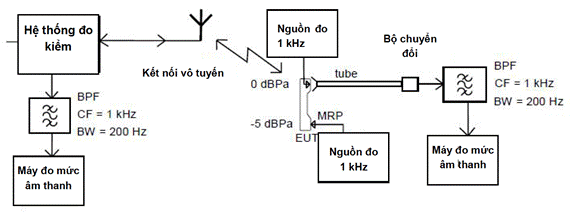
Figure 1. Audio breakthrough measurement, calibration set-up for portable equipment
...
...
...
Mọi chi tiết xin liên hệ: ĐT: (028) 3930 3279 DĐ: 0906 22 99 66
The voice processor may apply noise and echo cancellation algorithms which attempt to eliminate or reduce steady state audio signals as e.g. the 1 kHz calibration signals.
When the audio levels are measured during testing the EUT software shall be configured for voice applications. If the algorithms for noise and echo cancellation are not disabled, then the level shall be measured using a max-hold detection on the audio level meter in order to determine the level before the noise and echo cancellation algorithms become effective.
Set the EUT volume to provide the nominal audio level if specified by the manufacturer. If no such level is specified, the centre volume step shall be used. The volume settings shall be recorded in the test report.
The level of the output signal from the downlink speech channel of the EUT at the mobile or portable's earpiece shall be assessed by measuring the Sound Pressure Level (SPL) as shown in figure 2. When an external loudspeaker is used the acoustic coupler shall be fixed to the loudspeaker in the position used during the calibration.
The level of the decoded output signal from the uplink speech channel of the EUT at the analogue output of the test system shall be measured. Pick up of extraneous background noise by the microphone of the EUT shall be minimized by sealing the speech input port (microphone) of the EUT (see figure 2).
If the equipment is designed for use with external transducers, they shall be included in the test configuration. If the equipment does not include acoustical transducers the line voltage developed across a specified termination impedance may be measured.
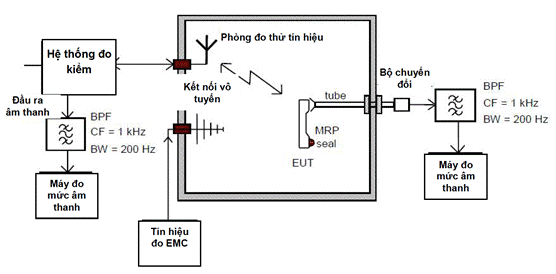
Figure 2: Audio breakthrough measurement, test set-up for portable equipment
2.3.2.2. Arrangements for test signals for CDMA Direct Spread (UTRA and E-UTRA)
...
...
...
Mọi chi tiết xin liên hệ: ĐT: (028) 3930 3279 DĐ: 0906 22 99 66
- The wanted RF signal nominal frequency shall be selected by setting the UTRA or E-UTRA Absolute Radio Frequency Channel Number (UARFCN or EARFCN) to an appropriate number;
- A communication link shall be set up with a suitable base station simulator (hereafter called "the test system"). The test system shall be located outside of the test environment;
- Where possible the test of the transmitter section and receiver section of the EUT may be carried out simultaneously to reduce test time.
Immunity tests shall be performed in two modes of operation:
- with a communication link established (traffic mode); and
- in the idle mode.
When the EUT is required to be in the traffic mode, a call is set up according to the Generic call set-up procedure and the following conditions shall be met:
...
...
...
Mọi chi tiết xin liên hệ: ĐT: (028) 3930 3279 DĐ: 0906 22 99 66
- the DTX shall be disabled;
- Inner Loop or Up Link Power Control shall be enabled;
- for UTRA the transmitting and/or receiving (UL/DL) bit rate for reference test channel shall be 12,2 kbit/s. E-UTRA the transmitting and/or receiving (UL/DL) bit rate for reference test channel shall be the reference measurement channel as specified in Annex C in ETSI TS 136 101 with parameters specified in tables 7.3.1-1 and 7.3.1-2 in ETSI TS 136 101;
- For UTRA see ETSI TS 134 108 and ETSI TS 134 109 Logical Test Interface for details regarding generic call set-up procedure and BER, BLER test loop scenarios; for E-UTRA see ETSI TS 136 508 and ETSI TS 136 509 for details regarding generic call set-up procedure and throughput test loop scenarios.
When the EUT is required to be in the idle mode the following conditions shall be met:
- UE shall be camped on a cell;
- UE shall perform Location Registration (LR) before the test, but not during the test;
- UE's neighbour cell list shall be empty;
- paging repetition period and DRX cycle shall be set to minimum (shortest possible time interval).
...
...
...
Mọi chi tiết xin liên hệ: ĐT: (028) 3930 3279 DĐ: 0906 22 99 66
2.3.2.3. Arrangements for test signals at the input of transmitters
The provisions of QCVN 18:2014/BTTTT, A.2.1 shall apply. For GSM and DCS, A.2.1 in QCVN 18:2014/BTTTT shall apply with the following modifications:
- The test system shall command the EUT to disable Discontinuous Transmission (DTX);
- A communication link shall be set up between the EUT and the test system.
2.3.2.4. Arrangements for test signals at the output of transmitters
The provisions of QCVN 18:2014/BTTTT, A.2.2 shall apply with the following modifications:
- Where the equipment incorporates an external 50 Ω RF antenna connector that is normally connected via a coaxial cable, then the wanted signal to establish a communication link shall be delivered from that connector by a coaxial cable.
- Where the equipment incorporates an external 50 Ω RF antenna connector, but this port is not normally connected via a coaxial cable, and where the equipment does not incorporate an external 50 Ω RF connector (integral antenna equipment), then the wanted signal, to establish a communication link, shall be delivered from the equipment to an antenna located within the test environment.
2.3.2.5. Arrangements for test signals at the input of receivers
...
...
...
Mọi chi tiết xin liên hệ: ĐT: (028) 3930 3279 DĐ: 0906 22 99 66
The provisions of QCVN 18:2014/BTTTT, A.2.3 shall apply with the following modifications:
- Where the equipment incorporates an external 50 Ω RF antenna connector that is normally connected via a coaxial cable, then the wanted signal to establish a communication link shall be delivered from that connector by a coaxial cable.
- Where the equipment incorporates an external 50 Ω RF antenna connector, but this port is not normally connected via a coaxial cable, and where the equipment does not incorporate an external 50 Ω RF connector (integral antenna equipment), then the wanted signal, to establish a communication link, shall be delivered from the equipment to an antenna located within the test environment.
2.3.2.5.2. Arrangements for test signals at the input of GSM and DCS receivers
The wanted RF input signal level shall be set to 40 dB above the reference sensitivity level as defined in ETSI TS 100 911, clause 6.2 to provide a stable communication link.
2.3.2.5.3. Arrangements for test signals at the input of CDMA Direct Spread (UTRA and E-UTRA) receivers
For immunity testing the wanted RF signal level at the input of the EUT shall be at least 40 dB above the reference sensitivity level to provide a stable communication link. The reference sensitivity level is defined in ETSI TS 125 101 and ETSI TS 125 102 or ETSI TS 136 101.
For emission testing the wanted RF signal level at the input of the measuring receiver shall be no more than 15 dB above the reference sensitivity level, to ensure that it operates within its dynamic range.
2.3.2.6. Arrangements for test signals at the output of receivers
...
...
...
Mọi chi tiết xin liên hệ: ĐT: (028) 3930 3279 DĐ: 0906 22 99 66
The provisions of QCVN 18:2014/BTTTT, A.2.4 shall apply.
When the EUT is required to be in the idle mode, the test system shall simulate a Base Station (BS) with Broadcast Control Channel/Common Control Channel (BCCH/CCCH) on one carrier. The EUT shall be synchronized to the BCCH, listening to the CCCH and able to respond to paging messages. Periodic Location Updating shall be disabled.
2.3.2.6.2. Arrangements for test signals at the output of CDMA Direct Spread (UTRA and E-UTRA) receivers
The provisions of QCVN 18:2014/BTTTT, A.2.4 shall apply. The specific arrangements for test signals at the output of receivers are in annexes A and B.
2.3.3.1. GSM and DCS Receiver and receivers of duplex transceivers exclusion band
The provisions of QCVN 18:2014/BTTTT, A.3 shall apply.
The exclusion band for receivers and receiver sections of transceivers is the band of frequencies over which no immunity tests with radiated RF are made.
2.3.3.2. GSM and DCS Transmitter exclusion band
The provisions of QCVN 18:2014/BTTTT, A.3 shall apply.
...
...
...
Mọi chi tiết xin liên hệ: ĐT: (028) 3930 3279 DĐ: 0906 22 99 66
2.3.3.3. CDMA Direct Spread (UTRA and E-UTRA) Transmitter exclusion band
The provisions of QCVN 18:2014/BTTTT, A.3 shall apply.
2.3.3.4. CDMA Direct Spread (UTRA and E-UTRA) Receiver exclusion band
The provisions of QCVN 18:2014/BTTTT, A.3 shall apply.
2.3.4.1. GSM and DCS Narrow band responses of receivers and receivers of duplex transceivers
Responses on receivers or duplex transceivers occurring during the test at discrete frequencies which are narrow band responses (spurious responses), are identified by the following method (the procedure below only applies if the separation between test frequencies exceeds 500 kHz):
- if during an immunity test the RXQUAL or speech output signal level being monitored goes outside the specified figure, it is necessary to establish whether the RXQUAL increase or speech output signal level increase is due to a narrow band response or to a wide band phenomenon. Therefore, the test shall be repeated with the unwanted signal frequency increased, and then decreased by 400 kHz;
- if the RXQUAL increase or speech output signal level increase disappears in either or both of the above 400 kHz offset cases, then the response is considered as a narrow band response;
- if the RXQUAL increase or speech output signal level increase does not disappear, this may be due to the fact that the offset has made the frequency of the unwanted signal correspond to the frequency of another narrow band response. Under these circumstances the procedure is repeated with the increase and decrease of the frequency of the unwanted signal set to 500 kHz;
...
...
...
Mọi chi tiết xin liên hệ: ĐT: (028) 3930 3279 DĐ: 0906 22 99 66
Narrow band responses are disregarded.
2.3.4.2. CDMA Direct Spread (UTRA and E-UTRA) Narrow band responses on receivers
2.3.4.2.1. UTRA
Responses on receivers or duplex transceivers occurring during the immunity tests at discrete frequencies, which are narrow band responses (spurious responses), are identified by the following method:
- if during an immunity test the quantity being monitored goes outside the specified tolerances, it is necessary to establish whether the deviation is due to an unwanted effect on the receiver of the UE or on the test system (narrow band response) or to a wideband (EMC) phenomenon. Therefore, the test shall be repeated with the UARFCN increased or decreased by:
+ FDD bands I, VIII.
- if the deviation does not disappear, the procedure is repeated with the UARFCN increased or decreased from the original value by:
+ FDD bands I, VIII.
- if the deviation does not disappear with the increased and/or decreased UARFCN, the phenomenon is considered wideband and therefore an EMC problem and the equipment fails the test.
...
...
...
Mọi chi tiết xin liên hệ: ĐT: (028) 3930 3279 DĐ: 0906 22 99 66
2.3.4.2.2. E-UTRA
Responses on receivers or duplex transceivers occurring during the immunity tests at discrete frequencies, which are narrow band responses (spurious responses), are identified by the following method:
- if during an immunity test the quantity being monitored goes outside the specified tolerances, it is necessary to establish whether the deviation is due to an unwanted effect on the receiver of the UE or on the test system (narrow band response) or to a wide band (EMC) phenomenon. Therefore, the test shall be repeated with the unwanted signal frequency increased or decreased by BWChannel MHz, where BWChannel is the channel bandwidth as defined in ETSI TS 136 101;
- if the deviation does not disappear, the procedure is repeated the unwanted signal frequency increased or decreased by 2 × BWChannel MHz,
- if the deviation does not disappear with the increased and/or decreased frequency, the phenomenon is considered wide band and therefore an EMC problem and the equipment fails the test.
Narrow band responses are disregarded.
2.3.5.1. GSM and DCS Normal test modulation
The immunity tests in voice call mode shall be performed without the application of any external modulation input signal.
For immunity tests in voice call mode, the overall audio uplink and downlink performance of the radio equipment shall be calibrated before the start of the tests. The calibration procedure is explained in clause 2.3.2.1.2.
...
...
...
Mọi chi tiết xin liên hệ: ĐT: (028) 3930 3279 DĐ: 0906 22 99 66
2.3.5.2. CDMA Direct Spread (UTRA and E-UTRA) Normal test modulation
For transmission of analogue speech or audio signals (voice call mode), immunity tests shall be performed without the application of any external modulation input signal.
The overall audio Up Link (UL) and Down Link (DL) performance of the radio equipment shall be calibrated before the start of the tests. The calibration procedure is explained in clause A.1..
The immunity tests in the data transfer mode shall be performed with the application of an appropriate external modulation input signal such that the performance of the data call can be monitored. For assessment of the data transfer mode, refer to Annex B.
The provisions of QCVN 18:2014/BTTTT, B.1 shall apply with the following modifications:
- The information about the bandwidth of the IF filter immediately preceding the demodulator as set out in Annex B in QCVN 18:2014/BTTTT is not applicable to radio equipment in the scope of the present document.
2.4.2.1. GSM and DCS Equipment with analogue speech circuits
The provisions of QCVN 18:2014/BTTTT, B.2 shall apply.
The performance of equipment which supports voice and data calls is assessed based on the voice call.
...
...
...
Mọi chi tiết xin liên hệ: ĐT: (028) 3930 3279 DĐ: 0906 22 99 66
The provisions of QCVN 18:2014/BTTTT, B.2 shall apply.
The assessment of the equipment performance shall be specified by the manufacturer.
The provisions of QCVN 18:2014/BTTTT, B.3 shall apply.
2.4.4.1. GSM and DCS Ancillary equipment
The provisions of QCVN 18:2014/BTTTT, B.4 shall apply with the following modifications:
- For emission measurements on transmitters performed in conjunction with associated ancillary equipment, the radiated emissions from the transmitter shall be ignored.
2.4.4.2. CDMA Direct Spread (UTRA and E-UTRA) Ancillary equipment
The provisions of QCVN 18:2014/BTTTT, B.4 shall apply with the following modifications:
- Ancillary equipment shall be tested with it connected to a UE in which case compliance shall be demonstrated to the appropriate clauses of the present document.
...
...
...
Mọi chi tiết xin liên hệ: ĐT: (028) 3930 3279 DĐ: 0906 22 99 66
- Portable or mobile equipment or combinations of equipment, when used in conjunction with a charger powered from the AC mains, shall in addition fulfil the requirements of radio and ancillary equipment for fixed use.
The equipment shall meet the performance criteria specified in this clause and clauses 2.5.1.2 to 2.5.1.4, as appropriate.
Portable equipment intended for use whilst powered by the main battery of a vehicle shall additionally fulfil the applicable requirements set out in QCVN 18:2014/BTTTT, clauses 2.1 and 2.2 for mobile equipment.
Portable or mobile equipment powered by the AC mains shall additionally fulfil the applicable requirements of QCVN 18:2014/BTTTT, clauses 2.1 and 2.2 for radio and ancillary equipment for fixed use.
The establishment and maintenance of a communications link, the assessment of RXQUAL, and the assessment of the audio breakthrough by monitoring the speech output signal level, are used as performance criteria to ensure that all primary functions of the transmitter and receiver are evaluated during the immunity tests. In addition, the test shall also be performed in idle mode to ensure the transmitter does not unintentionally operate.
The maintenance of a communications link shall be assessed using an indicator which may be part of the test system or the EUT.
If an equipment is of a specialized nature, such that the performance criteria described in the following clauses are not appropriate, then the manufacturer shall declare, for inclusion in the test report, his own specification for an acceptable level of performance or degradation of performance during. The performance specification shall be included in the product description and documentation.
The performance criteria specified by the manufacturer shall give the same degree of immunity protection as called for in the following clauses.
A communication link shall be established at the start of the test, see clauses 2.3.2.
...
...
...
Mọi chi tiết xin liên hệ: ĐT: (028) 3930 3279 DĐ: 0906 22 99 66
NOTE: When there is a high level background noise present the filter bandwidth can be reduced down to a minimum of 40 Hz.
At the conclusion of the test, the EUT shall operate as intended with no loss of user control functions or stored data, and the communication link shall have been maintained. In addition to confirming the above performance during a call, the test shall also be performed in idle mode, and the transmitter shall not unintentionally operate.
A communication link shall be established at the start of the test, see clause 2.3.2.
At the conclusion of each exposure the EUT shall operate with no user noticeable loss of the communication link.
At the conclusion of the total test comprising the series of individual exposures, the EUT shall operate as intended with no loss of user control functions or stored data, as declared by the manufacturer, and the communication link shall have been maintained.
In addition to confirming the above performance during a call, the test shall also be performed in idle mode, and the transmitter shall not unintentionally operate.
A communication link shall be established at the start of the test, see clause 2.3.2.
During the test, the RXQUAL of the downlink shall not exceed the value of three, measured during each individual exposure in the test sequence.
During the test, the downlink speech output level shall be at least 35 dB less than the previously recorded reference levels, when measured through an audio band pass filter of width 200 Hz, centred on 1 kHz (audio breakthrough check).
...
...
...
Mọi chi tiết xin liên hệ: ĐT: (028) 3930 3279 DĐ: 0906 22 99 66
At the conclusion of the test, the EUT shall operate as intended with no loss of user control functions or stored data, and the communication link shall have been maintained.
A communication link shall be established at the start of the test, see clause 2.3.2.
At the conclusion of each exposure the EUT shall operate with no user noticeable loss of the communication link.
At the conclusion of the total test comprising the series of individual exposures, the EUT shall operate as intended with no loss of user control functions or stored data, as declared by the manufacturer, and the communication link shall have been maintained.
The provisions of QCVN 18:2014/BTTTT, C.4 shall apply.
2.5.2.1. General
The equipment shall meet the performance criteria specified in this clause and clauses 2.5.2.2 and 2.5.2.3 as appropriate.
The maintenance of a communications link shall be assessed by using an indicator, which may be part of the test system or the equipment under test.
If an equipment is of a specialized nature, such that the performance criteria described in the following clauses are not appropriate, then the manufacturer shall declare, for inclusion in the test report, his own specification for an acceptable level of performance or degradation of performance during. The performance specification shall be included in the product description and documentation.
...
...
...
Mọi chi tiết xin liên hệ: ĐT: (028) 3930 3279 DĐ: 0906 22 99 66
In addition, the test shall also be performed in idle mode to ensure the transmitter does not unintentionally operate.
2.5.2.2. Performance criteria for continuous phenomena
2.5.2.2.1. General
A communication link shall be established at the start of the test.
In the speech mode, the performance criteria shall be that the Up Link and Down Link speech output levels shall be at least 35 dB less than the recorded reference levels, when measured through an audio band pass filter of width 200 Hz, centred on 1 kHz (Annex A).
NOTE: When there is a high level of background audio noise present, the filter bandwidth can be reduced down to a minimum of 40 Hz.
At the conclusion of the test, the EUT shall operate as intended with no loss of user control functions or stored data, and the communication link shall have been maintained.
In addition to confirming the above performance during a call, the test shall also be performed in idle mode, and the transmitter shall not unintentionally operate.
2.5.2.2.2. UTRA
...
...
...
Mọi chi tiết xin liên hệ: ĐT: (028) 3930 3279 DĐ: 0906 22 99 66
- if the BER (as referred in ETSI TS 134 109) is used, it shall not exceed 0,001 during the test sequence;
- if the BER (as referred in ETSI TS 134 109) is used, it shall not exceed 0,01 during the test sequence.
The BLER calculation shall be based on evaluating the CRC on each transport block.
2.5.2.2.3. E-UTRA
In the data transfer mode, the performance criteria shall be that the throughput shall be ≥ 95 % of the maximum throughput of the reference measurement channel as specified in Annex C in ETSI TS 136 101 with parameters specified in tables 7.3.1-1 and 7.3.1-2 in ETSI TS 136 101 during the test sequence.
2.5.2.3. Performance criteria for Transient phenomena
A communications link shall be established at the start of the test, clauses 2.3.1 and 2.3.2.
At the conclusion of each exposure the EUT shall operate with no user noticeable loss of the communication link.
At the conclusion of the total test comprising the series of individual exposures, the EUT shall operate as intended with no loss of user control functions or stored data, as declared by the manufacturer, and the communication link shall have been maintained.
...
...
...
Mọi chi tiết xin liên hệ: ĐT: (028) 3930 3279 DĐ: 0906 22 99 66
3.1. Equipment in the scope of Clause 1.1 of the present document must comply with technical requirements specified in the present document and have its conformity declared under the present document.
3.2. For GSM mobile terminals, the present document shall apply instead of QCVN 86:2015/BTTTT for the purpose of complying with regulations on conformity declaration of the Ministry of Information and Communications.
3.3. For W-CDMA FDD mobile terminals and E-UTRA FDD mobile terminals, the present document shall apply instead of QCVN 18:2014/BTTTT for the purpose of complying with regulations on conformity declaration of the Ministry of Information and Communications.
Relevant organizations and individuals shall comply with regulations on declaration of conformity of equipment in the scope of the present document and be subject to inspection by regulatory agencies in accordance with applicable regulations.
5.1. Vietnam Telecommunications Authority, Authority for Radio Frequency Management and Departments of Information and Communications shall provide guidelines for management of radio equipment in accordance with this document.
5.2. In the cases where any of the provisions referred to in this document is amended or replaced, the newest one shall apply.
5.3. Difficulties that arise during the implementation of this document should be reported to the Ministry of Information and Communications (the Department of Science and Technology) for instructions and resolution./.
A.1. Calibration of audio levels
...
...
...
Mọi chi tiết xin liên hệ: ĐT: (028) 3930 3279 DĐ: 0906 22 99 66
Set the EUT volume to provide the nominal audio level if specified by the manufacturer. If no such level is specified, the centre volume step shall be used.
Prior to the test sequence, the reference level of the speech output signal on both the downlink and uplink shall be recorded on the test instrumentation, as shown in figure A.1. The reference level shall be equivalent to the SPL of 0 dBPa at 1 kHz at the input of the acoustical coupler described ETR 027 for the downlink, and -5 dBPa at 1 kHz at the mouth reference point (MRP) defined in Recommendation ITU-T P.64 for the uplink.
NOTE 1: The MRP is defined with respect to an artificial head defined in Recommendation ITU-T P.76. The handset should be mounted on the artificial head such that the ear piece is centred at the artificial ear.
NOTE 2: If the equipment does not include acoustical transducers (e.g. a microphone or loudspeaker) the manufacturer should specify the equivalent electrical reference levels.
The voice processor may often apply noise and echo cancellation algorithms, which attempt to eliminate or reduce steady state audio signals as e.g. the 1 kHz calibration signals. These algorithms may be disabled during the calibration procedure. Specialized test software may be required. If the algorithms cannot be disabled then the reference level shall be measured using a max-hold detection on the audio level meter in order to determine the level before the noise and echo cancellation algorithms become effective.
Normally no corrections are made to the uplink reference level. The manufacturer shall specify the distance between the MRP and the microphone.
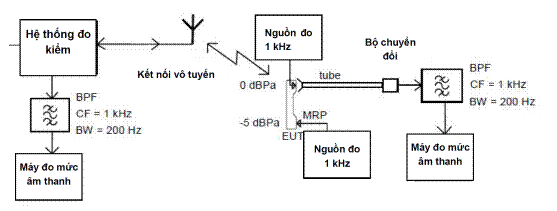
Figure A.1. Audio breakthrough measurement, calibration set-up for portable equipment
NOTE: The EUT is in position during calibration of the uplink, but not during calibration of the downlink where the EUT is replaced by the 1 kHz test audio source. During calibration of the uplink the mouthpiece shall be placed with respect to the MRP in a way representing intended use.
...
...
...
Mọi chi tiết xin liên hệ: ĐT: (028) 3930 3279 DĐ: 0906 22 99 66
When the audio levels are measured during testing the EUT software shall be configured for voice applications. If the algorithms for noise and echo cancellation are not disabled, then the level shall be measured using a max-hold detection on the audio level meter in order to determine the level before the noise and echo cancellation algorithms become effective.
The level of the output signal from the downlink speech channel of the EUT at the mobile or portable's ear piece shall be assessed by measuring the Sound Pressure Level (SPL) as shown in figure A.2. When an external loudspeaker is used the acoustical coupler shall be fixed to the loudspeaker in the position used during the calibration. The level of the decoded output signal from the uplink speech channel of the EUT at the analogue output of the test system shall be measured. Pick up of extraneous background noise by the microphone of the EUT shall be minimized.
NOTE: If the equipment is designed for use with external transducers, they should be included in the test configuration. If the equipment does not include acoustical transducers the line voltage developed across specified termination impedance may be measured.
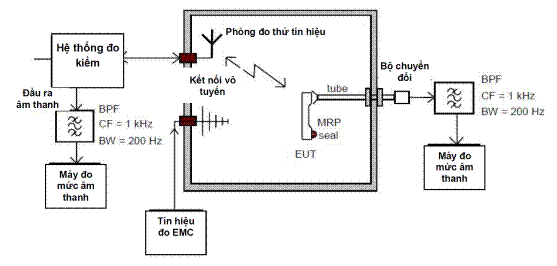
Figure A.2. Audio breakthrough measurement, test set-up for portable equipment
CDMA Direct Spread Performance assessment of data transfer call. Error Ratios
B.1.
Calibration of data transfer
B.1.1. UTRA
...
...
...
Mọi chi tiết xin liên hệ: ĐT: (028) 3930 3279 DĐ: 0906 22 99 66
B.1.2. E-UTRA
For the EUT, calibration of the data transfer may be performed by assessing the throughput percentage before applying the RF immunity test signal.
B.2. Assessment of data transfer
B.2.1. UTRA. Derivation of Error Ratios
The manufacturer shall provide the method for calculating the Error Ratio. Known data patterns shall be transferred bi-directionally from end-to-end (the whole of the UL and DL will be exercised). Performance assessment shall be made at each frequency step. Comparison between transmitted known data and received data shall result in the Error Ratio.
The data patterns used should be of sufficient length to give valid results and should be equivalent to the used channel bit rate.
Possible data patterns for assessing the Error Ratio are BER, BLER and User Data. Detailed description of BER and BLER can be found from ETSI TS 134 109.
End-User Data may be used where BER and BLER measurements are not appropriate and is a manufacturer's decision.
EXAMPLE: In the cases when the EUT consists of UE with data application ancillary and the data application ancillary itself does not support a loopback function that can be applied for the assessment of BER or BLER, as specified in ETSI TS 134 109. This would lead into a situation where the data application ancillary is not exercised, i.e. the data transfer loop is not end-to-end.
...
...
...
Mọi chi tiết xin liên hệ: ĐT: (028) 3930 3279 DĐ: 0906 22 99 66
Following formula may apply to End-User Data:
Error Ratio
=
erroneuos(bits, bytes,symbols,etc.)
x 100
=
n%
total number of (bits, bytes,symbols,etc.)
(In case that high Error Ratios exist, ensure that errors are a consequence of EMC stress.)
...
...
...
Mọi chi tiết xin liên hệ: ĐT: (028) 3930 3279 DĐ: 0906 22 99 66
The data patterns used should be of sufficient length to give valid results and should be equivalent to the used channel bit rate.
B.3. EUT without data application ancillary
Data monitoring Devices are here considered as part of the Test System. Arrangements should be made by the manufacturer, if needed, to couple the Data monitoring Device by a method which does not affect the radiated electromagnetic field (e.g. ultrasonic or optical).
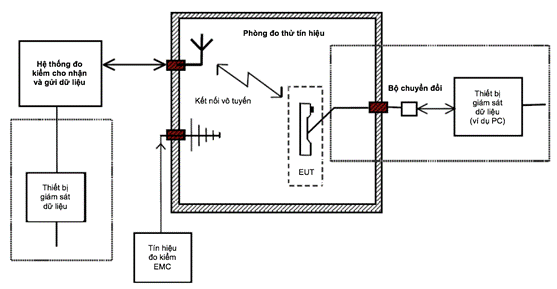
Figure B.1. Error Ratio or throughput assessment, test set-up for EUT without data application ancillary
B.4. EUT with data application ancillary
The Data monitoring Device is here considered as a part of the Test System. The Data application ancillary should be part of the data transfer (UL and DL) loop and is included in the EUT configuration.
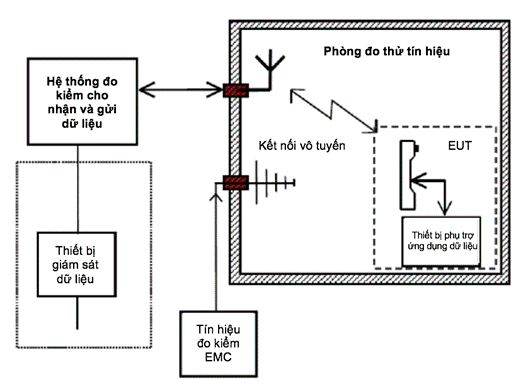
Figure B.2. Error Ratio or throughput assessment, test set-up for EUT with data application ancillary
...
...
...
Mọi chi tiết xin liên hệ: ĐT: (028) 3930 3279 DĐ: 0906 22 99 66
Annex C
(informative)
Examples of cellular mobile terminals and ancillary equipment
C.1.
Phase 1, Phase 2, and Phase 2+ GSM 900 MHz and DCS 1800 MHz digital cellular mobile terminals and ancillary equipment
Definitions for Phase 1, Phase 2, and Phase 2+ GSM 900 MHz and DCS 1800 MHz digital cellular mobile terminals and ancillary equipment are found in:
- ETSI I-ETS 300 034-1 for Phase 1 GSM 900 equipment
- ETSI I-ETS 300 034-2 for Phase 1 GSM 1800 equipment; or
- ETSI ETS 300 578 for Phase 2 GSM 900 or Phase 2 DCS 1800 equipment;
...
...
...
Mọi chi tiết xin liên hệ: ĐT: (028) 3930 3279 DĐ: 0906 22 99 66
C.2. Cellular mobile terminals and ancillary equipment for the IMT-2000 CDMA Direct Spread (UTRA)
Definitions for cellular mobile terminals and ancillary equipment for the IMT-2000 CDMA Direct Spread (UTRA) are found in:
- ETSI TS 125 101 and ETSI TS 125 102.
C.3. Cellular mobile terminals and ancillary equipment for the Evolved Universal Terrestrial Radio Access (E-UTRA)
Definitions for cellular mobile terminals and ancillary equipment for the Evolved Universal Terrestrial Radio Access (E-UTRA) are found in :
- ETSI TS 136 101.
Bibliography
[1] ETSI EN 301 489-52 V1.1.0 (2016-11) Electromagnetic Compatibility (EMC) standard for radio equipment and services; Part 52: Specific conditions for Cellular Communication Mobile and portable (UE) radio and ancillary equipment; Harmonised Standard covering the essential requirements of article 3.1(b) of Directive 2014/53/EU.
...
...
...
Mọi chi tiết xin liên hệ: ĐT: (028) 3930 3279 DĐ: 0906 22 99 66
- 1Decree No. 78/2018/ND-CP dated May 16, 2018 amending Decree 127/2007/ND-CP detailing the implementation of a number of Articles of the Law on Standards and Technical Regulations
- 2Decree No. 17/2017/ND-CP dated February 17, 2017 on functions, duties, powers and organizational structure of the Ministry of Information and Communications
- 3Law No. 41/2009/QH12 of November 23, 2009, on telecommunications
- 4Law No. 42/2009/QH12 of November 23, 2009, on radio frequencies
- 5Decree No. 127/2007/ND-CP of August 01, 2007, detailing the implementation of a number of articles of the Law on Standards and Technical Regulations
- 6Law No. 68/2006/QH11 of June 29, 2006 on standards and technical regulations
Circular No. 10/2019/TT-BTTTT dated October 04, 2019 on promulgation of "National technical regulation on electromagnetic compatibility for mobile terminals and ancillary equipment of digital cellular telecommunication systems"
- Số hiệu: 10/2019/TT-BTTTT
- Loại văn bản: Thông tư
- Ngày ban hành: 04/10/2019
- Nơi ban hành: Bộ Thông tin và Truyền thông
- Người ký: Nguyễn Mạnh Hùng
- Ngày công báo: Đang cập nhật
- Số công báo: Đang cập nhật
- Ngày hiệu lực: 01/07/2020
- Ngày hết hiệu lực: 01/01/2027
- Tình trạng hiệu lực: Kiểm tra
Đơn vị chủ quản: Công ty cổ phần tư vấn đầu tư và ứng dụng công nghệ 4.0.
Chịu trách nhiệm chính: Bà Phạm Hoài Thương.
Giấy chứng nhận ĐKDN số: 0108234370, do Sở Kế hoạch và Đầu tư thành phố Hà Nội cấp ngày 18/04/2018.
Địa chỉ: Thôn Trung, Xã Phù Đổng, TP Hà Nội - VPGD: C2 Vincom, 119 Trần Duy Hưng, Phường Yên Hòa, TP Hà Nội.
Hotline 1: 0342.799.688 - Hotline 2: 0985.426.175 - Email: info@hethongphapluat.com